 |
| John Keate |

Bishop Richard Durnford married Emma Keate. Emma was the daughter of John Keate, headmaster of Eton, and Canon of Windsor
Their children:
Mary Durnford
Fanny Louise Durnford 1842 d 1929 She died unmarried July 1929 at Midhurst
Richard M Durnford June 1843 d January 1934 m Beatrice Mary Selby 16 April 1884
Walter Durnford 1827 d 1926 He was unmarried
Sir Walter Durnford
 Younger son of the Right Rev. Richard Durnford, was educated at Eton (Hon. D.C.L. Durham, 1913), and D.D., Bishop of Chichester, who d. 1895, by Emma,was formerly Hon. Col. 3rd Batt. Northumberland who d. 1884, dau. of the late Rev. John Keate, D.D.,Head Master of Eton and Canon of Windsor
Sir Walter Durnford, b 1847 was educated at Eton and at King’s Coll., Cambridge (B.A. 1869, Fellow 1869-1918, M.A. 1872, Hon. LL.D 1918) is a JP for Cambridgeshire and for Cambridge and a Fellow of Eton College; was an Assistant Master at Eton 1870 - 99 formerly Major Comm. 4th Eton Coll. Vol, Batt Oxfordshire LI VD and Vice-Provost of King's College Cambridge. 1909 - 1918. elected Provost 1918. (Notes from Cambridge)
 |
| 1805 Harriet Beauchamp Proctor by Sir William Beechey (Ashridge Estate - Hertfordshire UK) |
Richard Durnford married Beatrice Mary Selby
She was the daughter of Prideaux Selby (baptised 21 December 1747 – 9 May 1813) and his wife Harriett Beauchamp-Proctor b 1782
Mary was the daughter of Thomas Beauchamp-Proctor and Mary Palmer
Her father was an English soldier and political figure in Upper Canada. He was born in Alnwick, Northumberland, England a son of the Holy Island branch of the Selby family
He joined the 5th Foot Regiment in Ireland in 1781, and arrived in Detroit with the regiment in 1790. In 1792, he was appointed assistant secretary of Indian Affairs by Lieutenant Governor John Graves Simcoe and took up residence in Amherstburg. In 1802, he became a justice of the peace in the Western District.
In 1807, he moved to York (Toronto). In 1808, he was appointed to the Executive Council of Upper Canada and appointed receiver general. In 1809, he was also appointed auditor general.
In the spring of 1813, he became seriously ill and died in May of the same year.
He had married in England in about 1772. His son, also Prideaux Selby was born in London and ultimately inherited family estates at Swansfield House, Alnwick and Pawston, Northumberland.
Richard Durnford was born in 1843 and he was at King's College he was a Solicitor and was also the Private Secretary to he Duke of Richmond.
Name: Richard. Durnford College: KING'S Entered: Michs. 1861 Born: 1844 Died: 10 Jan 1934 More Information: Adm. at KING'S, a scholar from Eton, Oct. 11, 1861. S. of Richard [R. of Middleton, Lancs., afterwards Bishop of Chichester]. B. 1844. Matric. Michs. 1861; B.A. (Class. Trip., 1st Class) 1865; M.A. 1868; Camden Medal, 1864. Fellow, 1866-85. Adm. at the Inner Temple, Jan. 20, 1866. Called to the Bar, 1869. Private Secretary to the Duke of Richmond, 1875-7. Assistant Charity Commissioner, 1877-1900. Secretary to the Charity Commissioners, 1900-8. J.P. for Hants. Attended the Bench regularly till he was well over 80. Retired, 1908, to Hartley Wespall House, Hants. Died there Jan. 10, 1934, aged 90. Brother of the next. (Eton Sch. Lists; Foster, Men at the Bar; King's Coll. Reg.; Law Lists; The Times, Jan. 12, 1934.)[1]
Richard and Mary were married 16th April 1884. Their children:
Richard Selby Durnford b 1885 d 1915
Hugh George Edmund Durnford b 1886 d 1965
Violet Mary Durnford b 1890 d 1982
Vice Admiral John Walter Durnford b 1891 d 1967
Beatrice Emma Durnford b 1893 d 1955
Robert Chichester Durnford b 1895 d 1918

1.1 Richard Selby Durnford was born in London, and he fought in World War I. He was killed at Hooge, in Belgium, and is remembered on the inner walls of the Menin Gate memorial.
| Captain Richard Selby DURNFORD From the Lancing College War Memorial | |
| D Company, 9th (Service) Battalion King’s Royal Rifle Corps Date of birth: October 1885 Date of death: 31st July 1915  Killed in action aged 1914 Commemorated on the Menin Gate Panels 51 and 53 | |
| Richard Selby Durnford was born at St Paul’s in London the eldest son of Richard M Durnford CB and Beatrice Mary (nee Selby) Durnford of Hartley Wespall House, Basingstoke in Hampshire. He was educated at Eton College where he was in Mr. H. Brinton’s House, where he was Captain of the Oppidans and was a member of the Officer Training Corps, leaving in 1904. He won a scholarship to King’s College Cambridge. He was placed in the first class of the Classical Tripos in 1907 and in the second class of the History Tripos in 1908. On leaving university he was an assistant master at Lancing College for one year in 1909, after which he left to become an assistant master at Eton College. While he was back at Eton he was commissioned as a 2nd Lieutenant in the Officer Training Corps on the 16th of April 1910. He was promoted to Captain in the Corps on the 22nd of May 1912. Following the outbreak of war he joined the King's Royal Rifle Corps with the rank of Temporary Captain on the 1st of October 1914. At 3.20am on the morning of the 30th of July 1915 the Germans attacked the British lines at Hooge in the Ypres Salient using a new weapon, that of "liquid fire". At noon that day the 9th Battalion King's Royal Rifle Corps were assembled in trenches just to the south of the Menin Road for an attack which had been planned, to recover those trenches which had been lost during the morning's fighting. A covering barrage on the German positions was ordered which lifted at 2.45pm when the King's men went forward, led by their bombers under Lieutenant H.S. Richmond. They were followed by B Company (Captain Tanqueray) and D Company (Captain Durnford) who rushed across the 200 yards of no man's land to the German positions which they carried at the point of the bayonet. Once in the trench a bombing battle took place and many casualties were suffered from enemy rifle and machine gun fire. The arrival of A Company who had been in reserve enabled the captured positions to be consolidated. In the early morning of the 31st the Germans fired a short but intense artillery barrage on the captured trenches followed by an infantry attack in an attempt to recover them. The enemy attack was driven off but Richard Durnford was killed during the fighting. Casualties suffered by the battalion over the two days of fighting were 17 officers and 322 other ranks. | |
| His brother Captain Robert Chichester Durnford DSO was killed in action in Mesopotamia on the 21st of June 1918 while serving with the 4th Battalion Hampshire Regiment. He is commemorated on the memorial at St Mary's Church at Wespall in Hampshire.  |
RICHARD SELBY DURNFORD
Great Britain
Captain 9th Bn., King’s Royal Rifle Corps.
Saturday, July 31, 1915
Eldest son of Richard Durnford C.B., and Beatrice Mary Durnford of Hartley Wespall, Hampshire (grandson of Bishop Durnford)
Killled in action at Hooge
Memorial: Ypres (Menin Gate) Memorial, Ieper, West-Vlaanderen, Belgium
Without a doubt, attending the 90th Anniversary of the end of World War I was one of the most moving and chilling experiences that we have done. To honour more than 54,000 whose names are engraved on the panels inside the memorial, to listen and pay our respects at the playing of the Last Post, where one elderley bugler had never missed a night in almost 60 years, (third from the right)

To walk amongst the thousands and thousands of War Graves, the whole experience is something which the travel agent in me says, put a visit on your bucketlist!


From 11th November, 1929 the Last Post has been sounded at the Menin Gate Memorial every night and in all weathers. The only exception to this was during the four years of the German occupation of Ypres from 20th May 1940 to 6th September 1944.
The daily ceremony was instead continued in England at Brookwood Military Cemetery, Surrey. On the very evening that Polish forces liberated Ypres the ceremony was resumed at the Menin Gate, in spite of the heavy fighting still going on in other parts of the town. Bullet marks can still be seen on the memorial from that time

1.3 Hugh George Edmund Durnford was born 1886 in Kensington in London. He served in World War I and was famous as the Author of the book The Tunnelers of Holzminden, not only as an author, but as one of the escapees. He was awarded the Military Cross.
 Hugh George British soldier, prisoner-of-war, and escapee in World War 1. Received the Military Cross.
He wrote a book about the escape, The Tunnellers of Holzminden (with a Side-Issue). 12 Sep 2013. by Hugh George Durnford
Durnford, Hugh George Edmund Lieutenant Royal Field Artillery British World War I (POW escape) 1919/05/05 (1920/01/30)[2] On 24th July 1918, Holzminden was the scene of the original "Great Escape" when 29 men escaped through a tunnel before it collapsed. Ten made it home; nineteen were re-captured. This famous incident was the inspiration for the film of that name transposed in time to the Second World War. The incident is documented in the book: "The Tunnellers of Holzminden" by Hugh George Edmund durnford (1920)
Hugh's Records from Forces War Records.
Hugh George Edmund
Surname: Durnford
Rank: Lieutenant
Gallantry Awards: Military Cross
Instituted on 28th December 1914 the Military Cross (M.C.) is the third level military decoration awarded to Officers.
This decoration was awarded to Hugh George Edmund Durnford for an act or acts of exemplary gallantry during active operations against the enemy.
The Military Cross (M.C.) is awarded for gallantry during active operations against the enemy.
Hugh George Edmund Durnford,as an owner of the Military Cross, is entitled to use the letters M.C. after his name.
Citations for the M.C. were published in the London Gazette during the Great War. However if the M.C. was a King’s Birthday or New Year award, details were not published and in most cases will not be available.
Gazette Info: Gazette Issue 31759. M.C. Awarded the Military Cross. His Majesty the King has been graciously pleased to approve of the undermentioned rewards in recognition of gallant conduct and determination displayed in escaping or attempting to escape from captivity, which services have been brought to notice in accordance with the terms of Army Order 193 of 1919. To date 5th May, 1919.
Gazette Date: 27/01/1920
Gazette Page: 1229
Service: British Army
Hugh George Edmund
Initials: H
Surname: Durnford
Nationality: British
Rank: Lieutenant
Gallantry Awards: Military Cross
Instituted on 28th December 1914 the Military Cross (M.C.) is the third level military decoration awarded to Officers. This decoration was awarded to Hugh George Edmund Durnford for an act or acts of exemplary gallantry during active operations against the enemy.
The Military Cross (M.C.) is awarded for gallantry during active operations against the enemy.

Hugh George Edmund Durnford,as an owner of the Military Cross, is entitled to use the letters M.C. after his name.
Citations for the M.C. were published in the London Gazette during the Great War. However if the M.C. was a King’s Birthday or New Year award, details were not published and in most cases will not be available.
Gazette Info: 1229
Gazette Date: 30/01/1920
Duty Location: Prisoner of War
Campaign Medals: Victory Medal
 Given the information we have available it is likely that Hugh George Edmund Durnford was entitled to the Victory medal, also called the Inter Allied Victory Medal. This medal was awarded to all who received the 1914 Star or 1914-15 Star and, with certain exceptions, to those who received the British War Medal. It was never awarded alone. These three medals were sometimes irreverently referred to as Pip, Squeak and Wilfred.
Eligibility for this award consisted of having been mobilised, fighting, having served in any of the theatres of operations, or at sea, between midnight 4th/5th August, 1914, and midnight, 11th/12th November, 1918. Women who served in any of the various military organisations in a theatre of operations were also eligible.

British War Medal
From the information available to us, it is very possible that Hugh George Edmund Durnford was entitled to the British War Medal for service in World War One. This British Empire campaign medal was issued for services between 5th August 1914 and 11th November 1918.
Holzminden prisoner-of-war camp was a World War I prisoner-of-war camp for British and British Empire officers (Offizier Gefangenenlager) located in Holzminden, Lower Saxony, Germany. It opened in September 1917, and closed with the final repatriation of prisoners in December 1918. It is remembered as the location of the largest PoW escape of the war, in July 1918: 29 officers escaped through a tunnel, of whom ten evaded subsequent recapture and managed to make their way back to Britain.
The prisoner-of-war camp opened at the beginning of September 1917, under the auspices of X Army Corps, headquartered in Hanover. Other camps for officers under the command of X Corps, all smaller, were those at Clausthal, Ströhen and Schwarmstedt. Many of the initial intake of prisoners were transferred from these camps, and others at Freiburg and Krefeld, which had become overcrowded.
The brothers had lived in Milwaukee, Wisconsin, for 17 years (until the spring of 1917, when the United States entered the war), and as a result Karl was able to speak English. However, his language was filled with idiomatic errors and slang terms: it was described by one prisoner as "bar-tender Yank";while another stated that Niemeyer "talked broken American under the impression that it was English".
The prisoners constantly ridiculed him, and nicknamed him "Milwaukee Bill". One error, which became notorious, was his assertion that "You think I do not understand the English, but I do. I know damn all about you."
The camp held between 500 and 600 officer prisoners. There were also approximately 100–160 other ranks prisoners, designated orderlies: these men acted as servants to the officers and performed other menial tasks around the camp.

 The camp occupied the premises of a cavalry barracks erected in 1913. The principal buildings, in which the prisoners lived, were two four-storey barrack blocks, known to the Germans as Kaserne A and Kaserne B, and to the British as A House and B House.
Although the greater part of both blocks housed officer prisoners, both were partitioned internally: the western end of Kaserne A formed the Kommandantur, in which the German garrison was quartered; while the eastern end of Kaserne B was occupied by the orderlies.
 |
| British Officers at the Camp |
From the outset, numerous officer prisoners attempted to escape from the camp. Techniques included cutting through the perimeter fence, and walking through the gates disguised as German guards, civilian workers, or (on at least one occasion) a woman.
Many of these escapes were successful in the first instance, but virtually all escapees were recaptured within a matter of days.
The largest and most celebrated escape was that made through a tunnel, on the night of 23/24 July 1918. The tunnel had been under excavation for some nine months. Its entrance was concealed under a staircase in the orderlies' quarters in Kaserne B. As officers were forbidden to enter the orderlies' quarters, in the early months the excavators had to reach it by disguising themselves in orderlies' uniforms.
At a later stage, a secret access door between the officers' and orderlies' quarters was created in the attic. Eighty-six officers were on the list of those waiting to use the tunnel but, on the night of the escape, the thirtieth man became stuck and the enterprise had to be abandoned.
Ten of the twenty-nine escapers (including the Senior British Officer in the camp, Colonel Charles Rathborne) succeeded in making their way to the neutral Netherlands and eventually back to Britain.
A fictionalised treatment of the tunnel escape from Holzminden was filmed as Who Goes Next?, and released in March 1938. It was directed by Maurice Elvey, and starred Barry K. Barnes
 There were 13 men involved in the digging, and others standing guard. It was agreed that the diggers would leave first, and would be followed by ‘the ruck’ – any other men who wanted out.
100 men were due to escape, but only 29 made it. At that point, the tunnel collapsed, and the 30th man became stuck. It must have been terrifying.
Of the 29 men, 19 were caught and 10 made their way to Holland safely on foot. Among the men who made it to Holland were the three ‘main’ diggers, who were great friends
History Extra
The official website of BBC History Magazine
 In June 1919 he married Margaret Evelyn Hope Meiklejohn.
She was born in 1895 the daughter of Brigadier-General William Hope Meiklejohn and his wife Maude Louisa Hamilton.
Marr: 15 August 1893 to Maude Louisa Hamilton, the second daughter of
Admiral Henry Hamilton and Blanche Georgina (Hughes) Beamish
Civ. Reg. Marriages Sep 1893 Beamish, Maud Louisa to Meiklejohn, William Hope Sevenoaks 2a 1127 (Kent, England)
 |
| Siege of Malakand |
Brigadier-General William Hope Meiklejohn CB CMG was a British military commander who, as a Colonel, was in charge of the British garrison during the siege of Malakand in northern Pakistan from July 26 to August 2, 1897, and who later led a relief force to the besieged fort of Chakdara along with Sir Bindon Blood, fighting against 50,000-100,000 Pashtun tribesmen and suffering only 206 casualties. Meiklejohn was later credited for his skills in providing such a victory in dispatches sent to the military government in British India.
William Meiklejohn
Allegiance: British Empire
Rank Brigadier-General
Commands held Malakand Field Force
Battles/wars Siege of Malakand July 26 - August 2, 1897
Awards: Companion in The Most Honourable Order of the Bath
Order of St Michael and St George
The siege was lifted when a relief column dispatched from British positions to the south was sent to assist General William Hope Meiklejohn, commander of the British forces at Malakand South. Accompanying this relief force was second lieutenant Winston Churchill, who later published his account as The Story of the Malakand Field Force: An Episode of Frontier War.
********************************************************************************
Her brother was Lieut Commander Ian Hamilton Hope Meiklejohn, He joined the Royal Navy September 1909
Ian Hamilton Hope
 Last name Meiklejohn
Service R.N.
Rank or rating Lieutenant
Medals/clasps earned 1914-15 Star, Victory & British War Medals
How issued or disposed of Mother.
Remarks No entry.
Record set Royal Navy Officers Medal Roll 1914-1920
Category Military, armed forces & conflict
Record collection First World War
Collections from Great Britain
I H H
Surname: Meiklejohn
Fate: Prisoner of War in Italy
Information: P.O.W. Camp number 35, Certosa di Padula Monastery, near Salerno, postal mark number 3400
Rank: Lieutenant Commander
Duty Location: Italy

I H H Surname: Meiklejohn
Resided Town: M & Mn (Marlag Ind Milag Nord) , Westertimke (Tarmstedt)
Nationality: British
Resided Country: (Prussia) Germany
Fate: Prisoner of War
 |
| British at Westerimke Camp |
INTERNATIONAL LAW (51): Officer captured by enemy in neutral waters: case of Lieut Commander I H Meiklejohn RN (Retd)
CLAN FERGUSON, ten merchant seaman including Master K N Vooght OBE, twenty Royal Navy ratings and two Royal Artillery gunners were lost. Italian ships picked up fifty three survivors, including Lt Cdr I H H Meiklejohn Rtd and Lt H Grimston RNR of SPARTIATE. Meikeljohn was taken to Germany and remained a POW for the rest of the war.
Barely an hour later the first serious damage was inflicted on the convoy when the Italian submarine AXUM fired four torpedoes damaging the cruisers CAIRO and NIGERIA and the tanker OHIO. NIGERIA had to withdraw to Gibraltar and CAIRO had to be sunk thus depriving the escort of the only ships fitted for fighter direction.
In consequence, with the convoy thrown into some disarray by the sinkings, when an air attack commenced about 30 minutes later the six Beaufighters overhead were powerless to intervene in the dusk. During this attack EMPIRE HOPE was bombed and abandoned, her survivors being picked up by PENN, CLAN FERGUSON was torpedoed and blew up, she was loaded with 2000 tons of aviation petrol and 1500 tons of explosives amongst other items, however 96 survivors reached the Tunisian coast to be interned by the French.
The BRISBANE STAR was torpedoed and fell out from the convoy, she will be referred to later. Finally, to complete the evening's chaos the Italian submarine ALAGI fired four torpedoes at KENYA just after 2100, the cruiser almost avoided all of them, only one striking her on the forefoot so that she was able to remain with the convoy capable of 25 knots.
0810 hrs JU 88s carry out a dive-bombing attack on the convoy, concentrating on SS Clan Ferguson, which receives a direct hit and blows up. HMS Charybdis reports seeing two aircraft dive on the merchantman and only one coming, the other is presumed destroyed in the explosion. Ledbury rescues 45 of her crew.
Marlag und Milag Nord was a World War II German prisoner-of-war camp complex for men of the British Merchant Navy and Royal Navy. It was located around the village of Westertimke, about 30 km (19 mi) north-east of Bremen, though in some sources the camp's location is given as Tarmstedt, a larger village about 4 km (2.5 mi) to the west.
Of more than 5,000 Allied merchant seamen captured by the Germans during the war, most were held at Marlag-Milag.[1] As civilian non-combatants, according to Section XI, Article 6, of the 1907 Hague Conventions, merchant seamen "...are not made prisoners of war, on condition that they make a formal promise in writing, not to undertake, while hostilities last, any service connected with the operations of the war."The Germans, however, always treated Merchant Navy seamen as POWs (as did the British from 1942). In 1943 the Germans suggested an exchange of equal numbers of Merchant Navy prisoners, but this offer was refused by the First Lord of the Admiralty A. V. Alexander on the grounds it would be more to Germany's benefit, as it would provide them with a large number of men suitable to be used as U-boat crews, of which they were desperately short.
Marlag and Milag Nord
Marlag, the Royal Navy camp, was divided into two compounds; "O" housed officers and their orderlies, while "M" held NCOs and ratings. The majority of prisoners were British, but there were also small numbers of other Allied nationalities.[4] In late 1942 all the ratings were sent to Stalag VIII-B at Lamsdorf and assigned to Arbeitskommando ("Work details"), and "M" housed only NCOs.[5]Milag (Marineinterniertenlager, "Marine internment camp"), the Merchant Navy camp, was 300 m (980 ft) to the east of Marlag. This also divided into two separate compounds for officers and men. The area in between contained the guard house, a prison block, fuel bunker, and the camp hospital.[4]
Just outside of the gates of Milag was the Kommandantur ("Headquarters") and accommodation for the guards. In between the camps there was a large shower block which was used by men of both camps.
Ian Hamilton Hope Meiklejohn married Dorothy Maude Campbell and they lived at Thomson's Falls
in Kenya 1949, according to the Kenya Gazette His wife traveled on the Orion.
 |
| Thompson Falls Nyahururu |
Ian Meiklejohn, who farmed near Thompson’s Falls, was slashed and his wife mutilated in November, 1952, killed by the Mau Mau.
Both were slashed at their home and he died two days later in hospital.
 |
| Retaliation by the British was swift |
Another side of the coin, this has been reported in the Daily Mail.
Barack Obama's grandfather was imprisoned for two years and tortured by white British soldiers during Kenya's bloody fight for independence, his family have said. (He worked as a cook for the British)
Read more: http://www.dailymail.co.uk/news/article-1091499
The Mau Mau conducted the most horrible actions, it was not a good time nor a good place to be.
My determination to find out what happened to him after surviving as a baby the riots in India, World War I and then the bombing of his ship and being interred in two prisoner of war camps, during World War II, was not what I had expected.
A sad conclusion to the research.
Richard Durnford 1920 d 1921
Susan Jennifer Durnford 1926 - 1984 m Humphrey Totterham
1.3 Violet Mary Durnford born 1890 in London She married in 1922 John Chaloner Chute
Captain in Eton College Regiment, Major Officer Training Corp


 He was an Archdeacon the 1941–1961 (res.): Jack Chute, Rector of Piddlehinton (until 1957)
Her was a member of the Chute Family from Hampshire.
There have been two baronetcies created for persons with the surname Chute, one in the Baronetage of England and one in the Baronetage of the United Kingdom. Both creations are extinct.
The Chute Baronetcy, of Hinxhill Place in the County of Kent, was created in the Baronetage of England on 17 September 1684 for Sir George Chute, subsequently Member of Parliament for Winchelsea.

 The title became extinct on his death in 1722. Chaloner Chute, Speaker of the House of Commons, was the member of a more senior branch of the Chute family seated at The Vyne in Hampshire.
The Chute Baronetcy, of The Vyne in the County of Southampton, was created in the Baronetage of the United Kingdom on 4 July 1952 for Charles Chute.
The title became extinct on his death in 1956. He left his estate The Vyne to the National Trust.
His brother Rev Anthony William Chute
 In the 1891 census, the Anthony was living at The Vyne with his family. His father, Challoner William (b.1839, London) was a magistrate living by his own means. His mother was Eleanor J. (b.1855, Oakley, Hampshire). 3 siblings were listed; Rachel E. (b.1877, Hampshire), Challoner L. (b.1880, Hampshire) and John C. (b.1882, Hampshire). All the children were scholars.
His medal card from WW1 shows that he was a Chaplain of the 4th class (equivalent to Captain), in the Royal Army Chaplains Dept. The card also indicates a title of O.B.E. although this has not been verified. The cards may indicate that he joined in December 1917. Another date is given in March 1925 in relation to the medals.
Reverend Chute had been vicar of St. Oswald's, West Hartlepool, Dean of Divinity at Magdalen College, Oxford, Honorary Chaplain to the Bishop of Durham and Examining Chaplain to the Bishop of Portsmouth.
Reverend Chute was inducted as vicar of Christ Church, Portswood on 28 August, 1929.
On the 31st August 1933, Anthony William Chute (aged 48) of Highfield Vicarage, Southampton, arrived in London aboard the Royal Mail Lines Ship, Highland Brigade. He had travelled from Las Palmas with John Challoner Chute (aged 51) of Eton College, Windsor and Violet Mary Chute (ged 40) of Hillstead, Basingstoke.
Reverend Chute left Highfield in 1936 to become vicar of St. Michaels, Basingstoke. He left having a reputation for significantly improving the church finances and having 'courtesy, charm and wisdom'.

 Today, the grounds of the rectory of St. Michaels, Basingstoke, form Glebe Gardens. In the north east corner of the gardens is Chute House, the Georgian rectory (built 1773, but much altered) named after Rev. Chute. In the 1960's it was replaced by a new-build rectory.
Source: http://www.basingstoke.gov.uk/leisure/parks/townparks/glebe.htm
Source: Highfield Church, Southampton 1847-1997, by Elizabeth Reader

1.4 John Walter Durnford born October 1891 in Kensington, died 7th February 1967 in Chelsea London.
He married Marie de Lancey Green on 22nd December 1936. Marie was an Australian, who was born in Warnambool, in Victoria in 1901.
 |
| HMS Argylle |
He served on the HMS Argyll, HMS Shannon and Submarine P 39 (1914-1918).
 |
| White Army Russia |
He served in World War I; naval advisor to
White Army, Russia (1919-1920)
Imperial Defense College (1936);
Chief Staff Officer, Malta (1937-1939)
 |
| In Melbourne 1941 |
World War II; Second Naval Member, Australian Commonwealth Naval Board (1941-1942)
He was the Commanding Officer of the HMS Suffolk 1939-1940
 |
| HMS Suffolk 1942 |
Director, RN Staff College (1944);
Director of Naval Training, Admiralty (1945-1947).
He retired in 1948 to Chelsea, England, where he served as local Mayor prior to his death.
 |
| His wife Marie launched the HMAS Mildura in 1941, the ship is no more. |
 |
| In July 1941, he traveled on the HMS Platypus to Darwin, where the troops were awaiting his arrival. |
At the time of the launch he was Acting Commander in Australia.
His papers at the IMPERIAL WAR MUSEUM, LONDON:
Papers, chiefly 1924-1952 (ref: P142, 143), including; semi-official correspondence 1924-1949; including two letters from V Adm Sir Thomas Hope Troubridge on the importance of training 1945; also two letters from AF Sir Algernon Usbourne Willis on the progress of operations in the Mediterranean 1943; typescript unpublished autobiography, written after his retirement in 1948, covering his career 1904-1948; photograph album relating to Durnford's career 1911-1920, including; photographs relating to his service in HMS ARGYLL, HMS SHANNON and Submarine P 39 1914-1918; photographs of the British Military Mission to South Russia 1919-1920: photographs relating to the Allied Control Commission, Constantinople, Turkey 1920.
British Military Mission
The Allied intervention was a multi-national military expedition launched during the Russian Civil War in 1918. The initial goals were to help the Czechoslovak Legions, secure supplies of munitions and armaments in Russian ports, and re-establish the Eastern Front. After winning World War I, the Allies militarily backed the anti-Bolshevik White forces in Russia. Allied efforts were hampered by divided objectives, war-weariness and a lack of public support. These factors, together with the evacuation of the Czechoslovak Legion compelled the Allies to withdraw from North Russia and Siberia in 1920, though Japanese forces occupied parts of Siberia until 1922 and the northern half of Sakhalin until 1925.[1]
The Allied intervention and its foreign troops were used effectively by the Bolsheviks to demonstrate that their enemies were backed by Western capital. Despite the Allies being able to withdraw in good order after significant defenses against the Red Army, the Bolsheviks were eventually victorious, leading to the establishment of the Soviet Union.
Papers, chiefly 1924-1952 (ref: P142, 143), including; semi-official correspondence 1924-1949; including two letters from V Adm Sir Thomas Hope Troubridge on the importance of training 1945; also two letters from AF Sir Algernon Usbourne Willis on the progress of operations in the Mediterranean 1943; typescript unpublished autobiography, written after his retirement in 1948, covering his career 1904-1948; photograph album relating to Durnford's career 1911-1920, including; photographs relating to his service in HMS ARGYLL, HMS SHANNON and Submarine P 39 1914-1918; photographs of the British Military Mission to South Russia 1919-1920: photographs relating to the Allied Control Commission, Constantinople, Turkey 1920.
British Military Mission
The Allied intervention was a multi-national military expedition launched during the Russian Civil War in 1918. The initial goals were to help the Czechoslovak Legions, secure supplies of munitions and armaments in Russian ports, and re-establish the Eastern Front. After winning World War I, the Allies militarily backed the anti-Bolshevik White forces in Russia. Allied efforts were hampered by divided objectives, war-weariness and a lack of public support. These factors, together with the evacuation of the Czechoslovak Legion compelled the Allies to withdraw from North Russia and Siberia in 1920, though Japanese forces occupied parts of Siberia until 1922 and the northern half of Sakhalin until 1925.[1]
 |
| Allied troops parading in Vladivostok, 1918 |
.
1.5 Beatrice Emma Durnford born 1890 died 1982. Beatrice married 2nd Lieut Arthur Prescott Barker who served in World War I in the Royal Army Service Corp. They were married in December 1925.
They had a son, John Durnford Barker born 1927 of Winchester he was a solicitor
Arthur Prescott was awarded the Order of the White Eagle by the King of Serbia in 1920.

Arthur Prescott
Surname: Barker
Information: Conferred by His Majesty the King of Serbia.
Rank: Temporary Lieutenant
Gallantry Awards: Order of the White Eagle
Order of the White Eagle was a Royal Order in the Kingdom of Serbia (1883–1918) and the Kingdom of Yugoslavia (1918–1945). King Milan I of Serbia instituted the Order of the White Eagle on 23 January 1883, concurrently with the Order of St. Sava.
The Order had five classes and was conferred on Serbian and Yugoslav citizens for achievements in peace or war, or for special merits to the Crown, the state and nation. In the period between 1883 and 1898 Order of the White Eagle was the highest award in the Kingdom of Serbia. In 1898 the Royal Order of Miloš the Great took precedence over the White Eagle and in 1904 the former was replaced by the Order of the Karađorđe's Star.
5th Class
Gazette Info: Gazette Issue No. 31796 – Order of the White Eagle, with Swords, 5th Class. - The following Decoration or Medal was awarded by the Allied Powers at various dates to the British Forces for distinguished services rendered during the course of the campaign. His Majesty the King has given unrestricted permission in all cases to wear the Decorations and Medals in Question.
1.5 Robert Chichester Durnford
Robert was born in 1895 and he joined the Army in 1914, aged 19. He was promoted eventually becoming an Acting Captain, of the 1/4th Hampshire Regiment.
 |
| In India |
August 1914 : in Winchester. Part of Hampshire Brigade in Wessex Division.
9 October 1914 : sailed for India, landing Karachi 11 November 1914. Attached to 4th (Rawalpindi) Brigade in 2nd (Rawalpindi) Division in January 1915.
 |
| Basra 1914 |
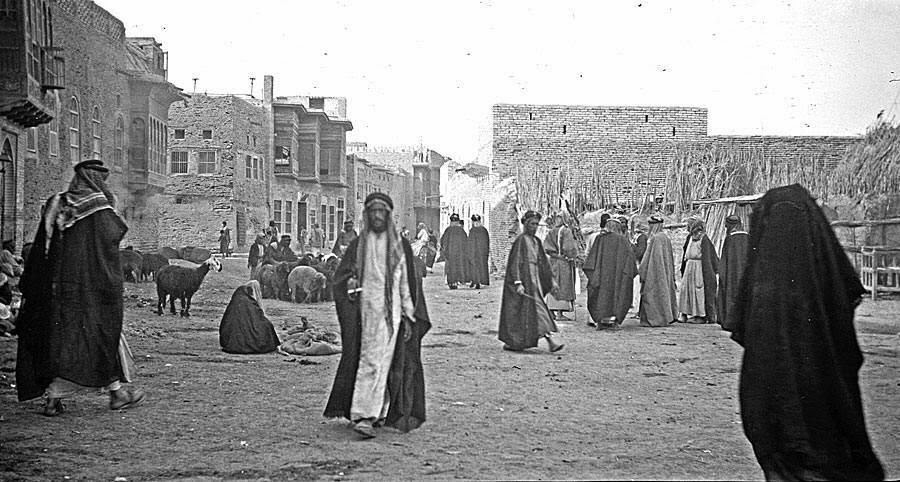
18 March 1915 : landed at Basra with 33rd Indian Brigade and remained in Mesopotamia and Persia for the rest of the war. Battalion HQ and one Company were captured at Kut-el-Amara on 29 April 1916.
The remainder formed a Composite Bn with the 1/5th Bn, the Buffs, and - attached to 35th Indian Brigade - transferred to 14th Indian Division. November 1916, transferred to 36th Indian Brigade.
 |
| British entering Baghdad |
2 January 1918: entered Persia with Lt Col Matthews' Column. C Company occupied Krasnodovsk on 26 August and pushed on to Merv; D Company occupied Resht and Enzeli.
A small detachment under Lt Fisher occupied Baku between 4 August and 15 September 1918.
In November Battalion HQ was at Zinjan. In June 1919 two Companies were attached to Lt Col Matthews' Motor Mobile Column and fought at Resht in August 1919.
Mentioned in Despatches in 1914 2nd Lieutenant R.C. Durnford
The Mesopotamian campaign was a campaign in the Middle Eastern theatre of World War I fought between the Allies represented by the British Empire, mostly troops from the Indian Empire and Australia, and the Central Powers, mostly of the Ottoman Empire.
The largest Indian Army force to serve abroad was the Indian Expeditionary Force D in Mesopotamia, under the command of Lieutenant-General Sir John Nixon. The first unit sent in November 1914, was the 6th (Poona) Division and they were tasked with guarding British oil installations in and around Basra.
As part of the Mesopotamian campaign they served under the command of Major General Barrett and then under Major General Townshend. After a string of early successes, the campaign was delivered a setback at the Battle of Ctesiphon in November 1915 due to Logistical constraints. Following this engagement, the Poona Division withdrew back to Kut, where Townshend made the decision to hold the city and the Siege of Kut began.
Between January and March 1916, Townshend launched several attacks in an attempt to lift the siege. In sequence, the attacks took place at the Battle of Sheikh Sa'ad, the Battle of the Wadi, the Battle of Hanna, and the Battle of Dujaila Redoubt
In 1917, the British force, under Frederick Stanley Maude, which now included one cavalry and seven infantry divisions from the Indian Army, in the III Corps (India) advanced towards Baghdad which was captured in March.[clarification needed] The advance continued in 1918, and after the Battle of Sharqat in October, the Turkish forces surrendered and the Armistice of Mudros was signed.
The Mesopotamian campaign was largely an Indian Army campaign as the only British formations involved were the 13th (Western) Division and British battalions assigned to Indian brigades. In the campaign, 11,012 were killed, 3,985 died of wounds, 12,678 died of disease, 13,492 were either missing or prisoners (including the 9,000 prisoners from Kut), and 51,836 were wounded.
He was awarded the DSO, for action in 1917. These two entries about the DSO from the Forces War Records.
Distinguished Service Order
 Instituted
on 6th September 1886 by Queen Victoria, the Distinguished Service
Order (D.S.O.) was awarded to R C Durnford for meritorious or
distinguished service during wartime.
The order was established for rewarding individual instances of meritorious or distinguished service in war. It was a military order, until recently for officers only and normally given for distinguished services during active operations against the enemy.
It is typically awarded to officers ranked Major (or its equivalent) or higher, but the honour has sometimes been awarded to especially valorous junior officers.
The recipient, R C Durnford,is known as a Companion of the Distinguished Service Order and is entitled to use the letters D.S.O. after his name.
Then he was in Iran as part of Dusterville's camaign.
Mission: 'the maintenance of an effective force on the Caucasus front so as to protect the occupied portions of Turkish Armenia and to prevent the realisation of Pan-Turanian designs'.
Part 1: The Fighting in North-West Persia During 1918. Dunsterforce, from The Western Front Association
To test the determination of the defences the two aircraft flew overhead without firing and were met by widespread Jangali rifle fire. Bicherakov then led his men towards the bridge and dispersed a Jangali picquet by shouting and waving his stick at it. Von Passchen appeared under a flag of truce demanding a parley in an attempt to separate the Cossacks from the British troops but Bicherakov verbally dismissed him.
Once von Passchen was out of the way the Russian gunners opened fire, the Cossack cavalry moved towards the enemy's right whilst the armoured cars engaged from his left and the infantry advanced. This caused the Jangalis on the near side of the river to flee from their trenches towards the bridge where many stragglers were captured.
All the Jangalis now fled from their positions and Bicherakov's column pursued them for 16 kilometres towards Resht. Bicherakov and his Cossacks pushed on to Enzeli after reorganising, leaving detachments at Resht and two other points on the road. Captain A V 'Darkie' Pope's 14th Hussars guarded the Menjil Bridge.
Dunsterville needed to get more men forward from Hamadan before he could secure his line of communications whilst he advanced. General Marshall had sent forward a composite battalion, half 1/4th Hampshires and half 1/2nd Gurkhas, under the command of Lieutenant Colonel C L Matthews, Durham Light Infantry attached to and commanding 1/4th Hampshires. This unit was accompanied by Right Section (two guns) of 21st Kohat Mountain Battery (Frontier Force), Indian Army.
The battalion and the gunners were titled 'Matthews' Column'. Some of the Hampshires now joined Dunsterville but the Jangalis, their morale recovered, gave them a warm welcome on 18 June by successfully ambushing a party on a small bridge at Siah Rud.


The stone bridge at Siah Rud which is the probable place of attack from any of the Jangli tribe. The enemy may snipe convoys from the above forests without much risk. It was at this point that the Hampshires suffered slight casualties.
Captain R C Durnford was killed and six men were wounded.
Three days later another successful Jangali ambush was sprung. For gallantry displayed on this occasion Lieutenant Geoffrey Watt, Motor Transport, Army Service Corps, received a Military Cross with the citation:
For conspicuous gallantry and devotion to duty between Menjil and Resht, Persia on 21 June, 1918. He was in command of a convoy of 66 vans which was heavily attacked by hostile irregulars. Eight vans were put out of action, but by his entire disregard of danger and good conduct he managed to salve them. Later, on three occasions he went out with a small party under fire and salved four more vans which had been abandoned.

A British officer from the Dunsterforce watches a Russian instructing a group of Persian police at Resht


He is buried in the Teheran Cemetery and like his brother is mentioned on the family plaque in St Mary's Church


